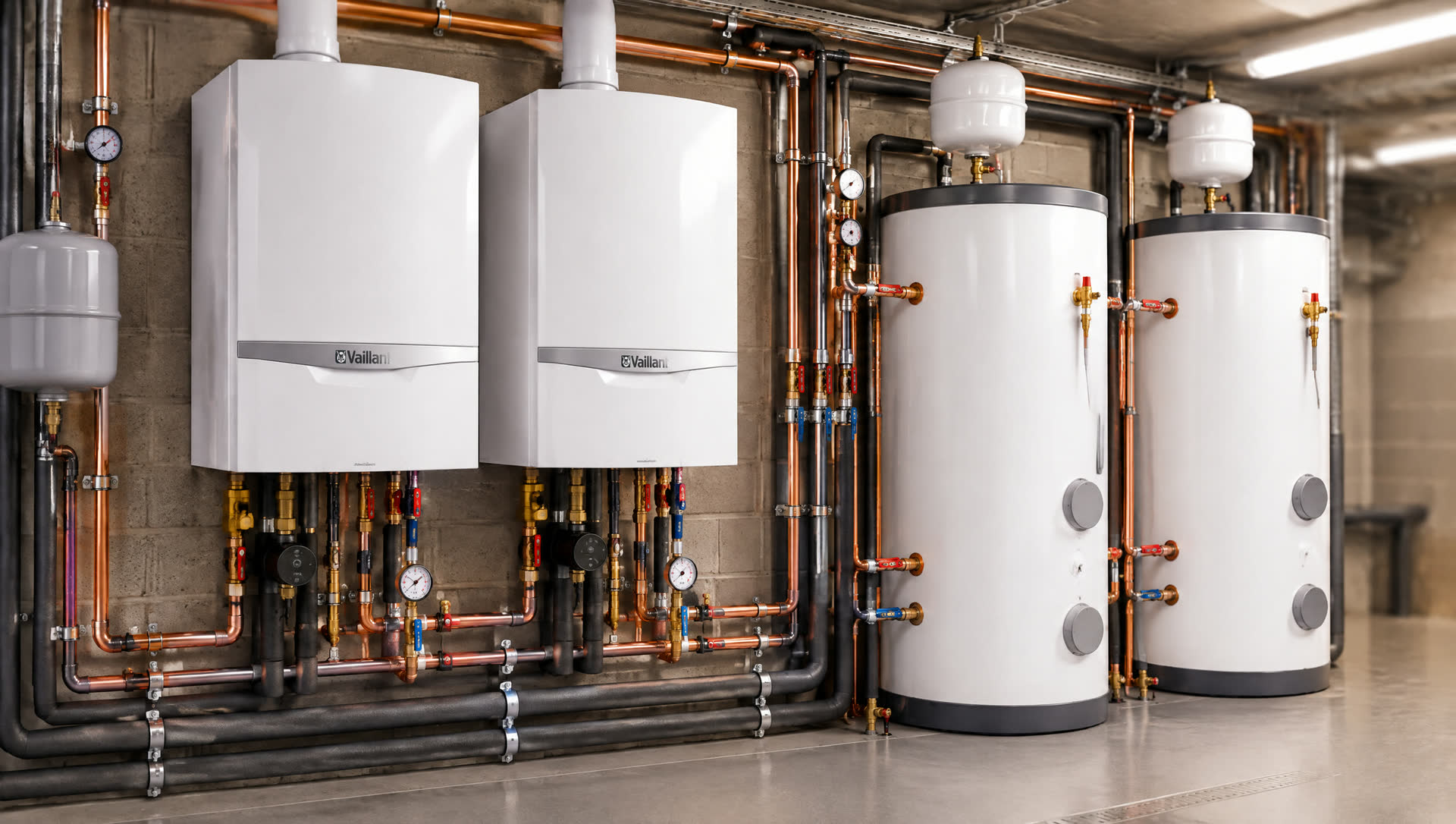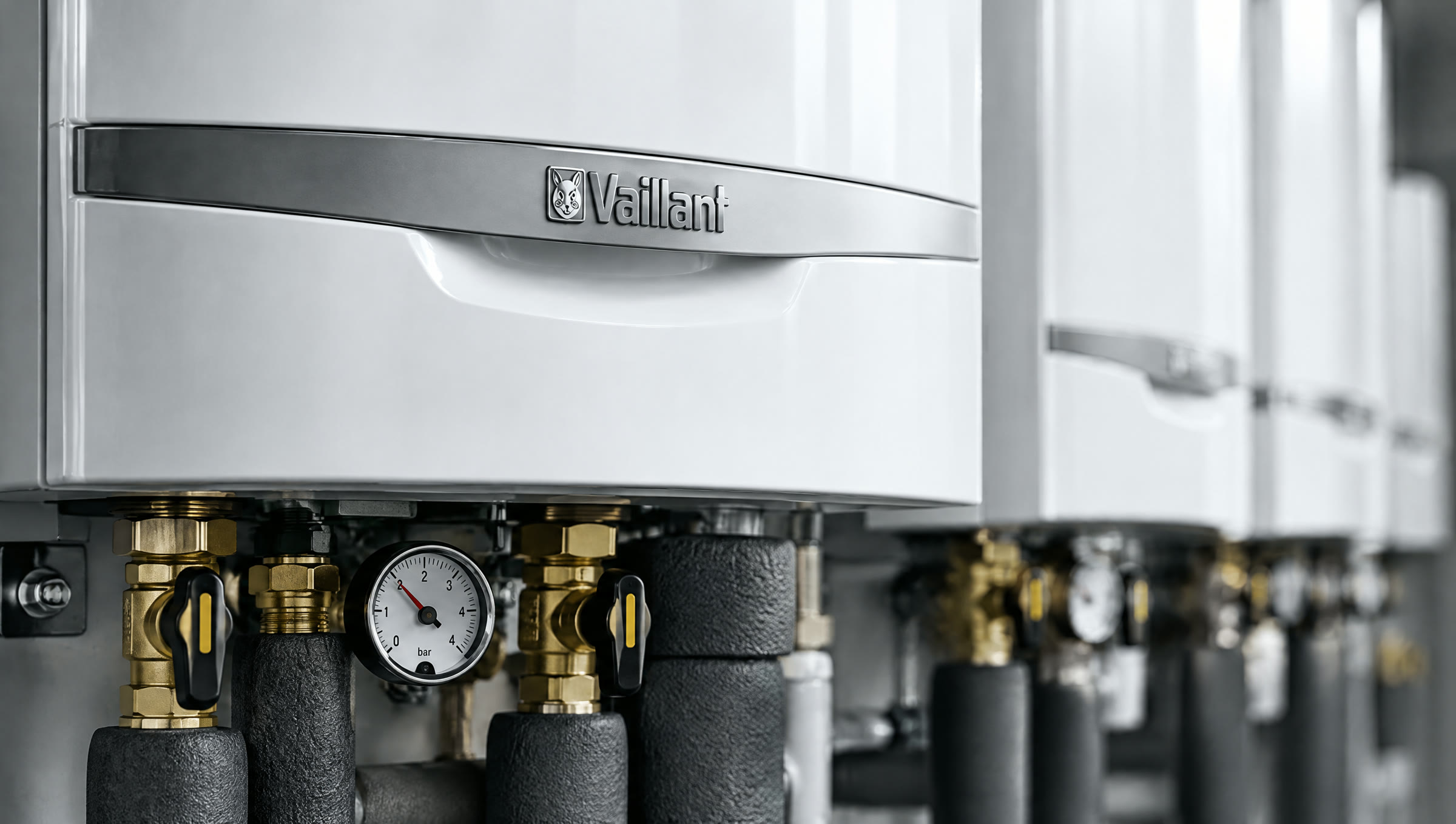
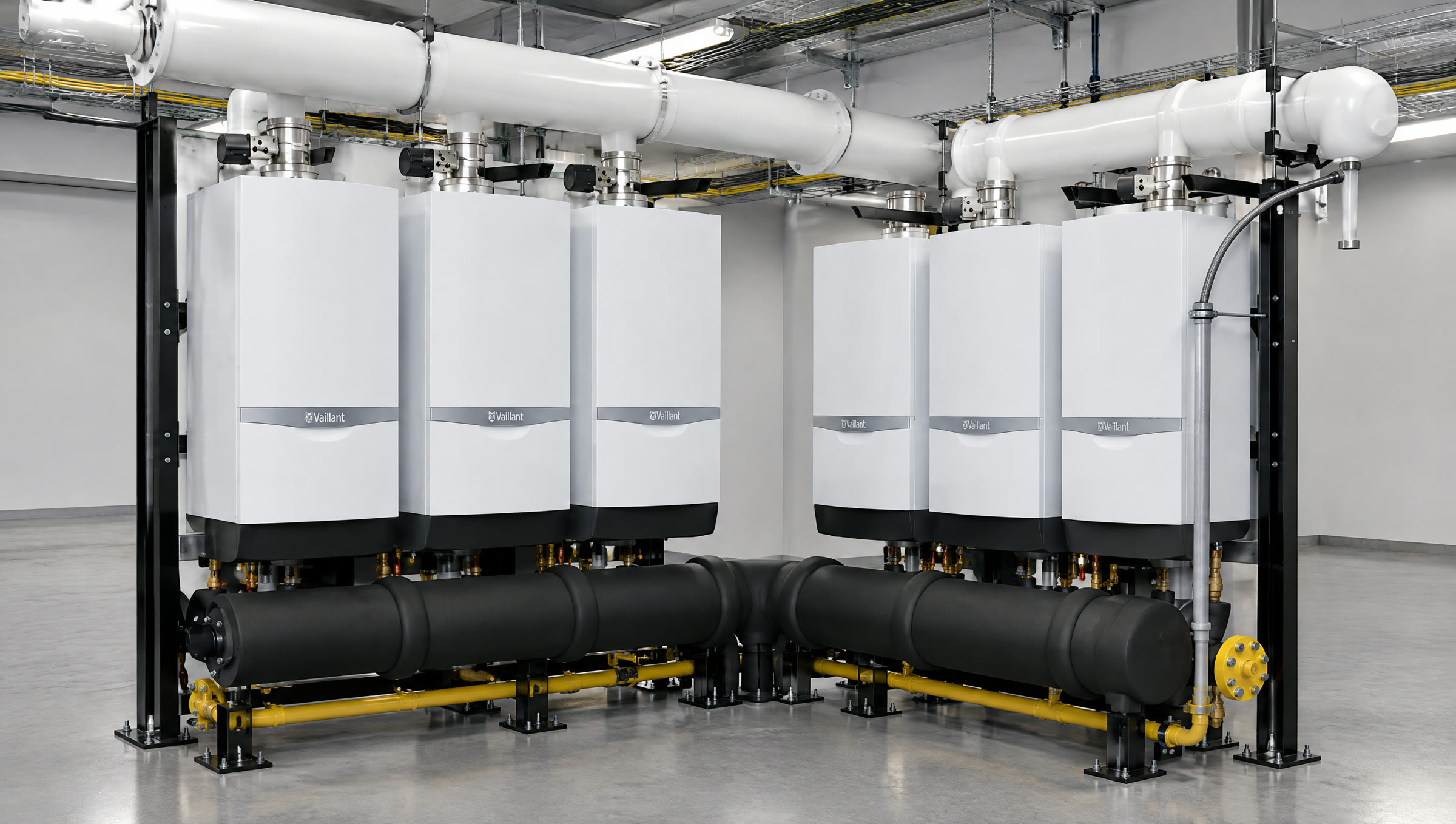
 Illustrative photo
Walk into a modern commercial plant room and you will often see a row of wall-hung boilers instead of one big floor-standing unit, with a fat vertical pipe beside them. That is a boiler cascade and a low loss header. Here is why they are there, in plain English.
What is a boiler cascade?
A cascade is two or more boilers working together as one heat source. A cascade controller watches how much heat the building needs and brings boilers on in stages: one boiler on a mild autumn morning, all of them on the coldest day of the year.
The benefits are practical:
- Efficiency across the year. A building only needs full heat output for a few weeks a year. Running one or two boilers near their best working point for the rest of the year is more efficient than one large boiler ticking over well below its capacity.
- Back-up built in. If one boiler fails or is being serviced, the others keep the heating and hot water running. For a care home or hotel, that matters more than anything else on this list.
- Easier to fit and replace. Smaller units fit through normal doors and up stairs to rooftop plant rooms, and a cascade can be extended later if the building grows.
What does a low loss header do?
A low loss header (also called a common header or hydraulic separator) sits between the boiler side of the system, the primary circuit, and the building side, the secondary circuits. As heating manufacturer Hamworthy explains, its job is hydraulic separation: when water enters the wide body of the header it loses most of its pumped speed, so each side can run at its own flow rate.
That matters because the building side keeps changing. Valves open and close, and modern variable-speed pumps speed up and slow down as rooms warm up. Without separation, those changes would push and pull on the flow through the boilers, and many commercial boilers need a steady minimum flow to run safely and efficiently. With a low loss header, the boilers get a constant flow while each heating circuit takes only what it needs.
Extra jobs a well-fitted header does
- Collects dirt. Fitted vertically, the slow water lets sludge and debris settle at the bottom, where it can be drained off during a service.
- Releases air. Air comes out of the water as it slows and rises to an automatic air vent at the top.
- Protects the boilers. Steady flow and cleaner water both help boilers last longer.
Some headers combine these jobs with a dedicated air and dirt separator. Hamworthy still recommends cleaning and flushing an existing system when new boilers go in, so old sludge does not end up inside them.
Getting the design right
A low loss header is not a fit-and-forget part. It has to be sized for the system's flow rates, temperatures and the boilers' minimum flow, and it needs correctly sized pumps on both sides: at least one primary pump for the boilers and one or more pumps for the heating circuits. Undersized secondary pumps leave the far end of the building cold; oversized ones waste energy, add noise and can upset the boilers' flow. On a simple system, with one boiler and one heating circuit, a header may not be needed at all.
That is why we look at the whole plant room, not just the boilers, when we survey a site. If your plant room has grown piece by piece over the years, a survey will show whether the boilers, header, pumps and controls are working together or against each other.